Contact Form

Name

Email *

Message *

Wednesday, August 14, 2013

“Love is a commitment that will be tested in the most vulnerable areas of spirituality, a commitment that will force you to make some very difficult choices. It is a commitment that demands that you deal with your lust, your greed, your pride, your power, your desire to control, your temper, your patience, and every area of temptation that the Bible clearly talks about. It demands the quality of commitment that Jesus demonstrates in His relationship to us.”
Ravi Zacharias, I, Isaac, Take Thee, Rebekah: Moving from Romance to Lasting Love
“We have a right to believe whatever we want, but not everything we believe is right.”
Ravi Zacharias
“I think the reason we sometimes have the false sense that God is so far away is because that is where we have put him. We have kept him at a distance, and then when we are in need and call on him in prayer, we wonder where he is. He is exactly where we left him.”
Ravi Zacharias, Has Christianity Failed You?
“What I believe in my heart must make sense in my mind.”
Ravi Zacharias
“In the 1950s kids lost their innocence.
They were liberated from their parents by well-paying jobs, cars, and lyrics in music that gave rise to a new term ---the generation gap.

In the 1960s, kids lost their authority.
It was a decade of protest---church, state, and parents were all called into question and found wanting. Their authority was rejected, yet nothing ever replaced it.

In the 1970s, kids lost their love. It was the decade of me-ism dominated by hyphenated words beginning with self.
Self-image, Self-esteem, Self-assertion....It made for a lonely world. Kids learned everything there was to know about sex and forgot everything there was to know about love, and no one had the nerve to tell them there was a difference.

In the 1980s, kids lost their hope.
Stripped of innocence, authority and love and plagued by the horror of a nuclear nightmare, large and growing numbers of this generation stopped believing in the future.

In the 1990s kids lost their power to reason. Less and less were they taught the very basics of language, truth, and logic and they grew up with the irrationality of a postmodern world.

In the new millennium, kids woke up and found out that somewhere in the midst of all this change, they had lost their imagination. Violence and perversion entertained them till none could talk of killing innocents since none was innocent anymore.”
Ravi Zacharias, Recapture the Wonder
“There is no greater discovery than seeing God as the author of your destiny.”
Ravi Zacharias
“Yes, if truth is not undergirded by love, it makes the possessor of that truth obnoxious and the truth repulsive.”
Ravi Zacharias
“I thank the Lord that, even though things were so wrong in my life here, I finally was brought to the realization of what all those struggles were about. There are some wonderful things from your painful past, things with a beauty you may not have realized at the time.”
Ravi Zacharias, Walking from East to West: God in the Shadows
“These days its not just that the line between right and wrong has been made unclear, today Christians are being asked by our culture today to erase the lines and move the fences, and if that were not bad enough, we are being asked to join in the celebration cry by those who have thrown off the restraints religion had imposed upon them. It is not just that they ask we accept, but they now demand of us to celebrate it too.”
Ravi Zacharias
“Unless I understand the Cross, I cannot understand why my commitment to what is right must be precedence over what I prefer.”
Ravi Zacharias, I, Isaac, Take Thee, Rebekah: Moving from Romance to Lasting Love
“I remember the time an older man asked me when I was young, "Do you know what you are doing now?" I thought it was some kind of trick question.
Tell me," I said.
You are building your memories," he replied, "so make them good ones.”
Ravi Zacharias
“I came to Him because I did not know which way to turn. I remained with Him because there is no other way I wish to turn. I came to Him longing for something I did not have. I remain with Him because I have something I will not trade. I came to Him as a stranger. I remain with Him in the most intimate of friendships. I came to Him unsure about the future. I remain with Him certain about my destiny. I came amid the thunderous cries of a culture that has 330 million deities. I remain with Him knowing that truth cannot be all-inclusive.”
Ravi Zacharias, Jesus Among Other Gods: The Absolute Claims of the Christian Message
“To sustain the belief that there is no God, atheism has to demonstrate infinite knowledge, which is tantamount to saying, “I have infinite knowledge that there is no being in existence with infinite knowledge”
Ravi Zacharias
“Time is the brush of God, as he paints his masterpiece on the heart of humanity.”
Ravi Zacharias
“What you applaud you encourage, but beware what you celebrate...”
Ravi Zacharias
“There can be no reproach to pain unless we assume human dignity, there is no reason for restraints on pleasure unless we assume human worth, there is no legitimacy to monotony unless we assume a greater purpose to life, there is no purpose to life unless we assume design, death has no significance unless we seek what is everlasting.”
Ravi Zacharias
“Faith in the biblical sense is substantive, based on the knowledge that the One in whom that faith is placed has proven that He is worthy of that trust. In its essence, faith is a confidence in the person of Jesus Christ and in His power, so that even when His power does not serve my end, my confidence in Him remains because of who He is.”
Ravi Zacharias, Jesus Among Other Gods: The Absolute Claims of the Christian Message

“With no fact as a referent, what is normative is purely a matter of preference.”
Ravi Zacharias, The Real Face of Atheism
“Capturing the beauty of the conversion of the water into wine, the poet Alexander Pope said, "The conscious water saw its Master and blushed." That sublime description could be reworked to explain each one of these miracles. Was it any different in principle for a broken body to mend at the command of its Maker? Was it far-fetched for the Creator of the universe, who fashioned matter out of nothing, to multiply bread for the crowd? Was it not within the power of the One who called all the molecules into existence to interlock them that they might bear His footsteps?”
Ravi Zacharias, Jesus Among Other Gods: The Absolute Claims of the Christian Message
“But life's joys are only joys if they can be shared.”
Ravi Zacharias
“The four absolutes we all have in our minds: love, justice, evil, and forgiveness.”
Ravi Zacharias
“It is easier to hide behind philosophical arguments, heavily footnoted for effect, than it is to admit our hurts, our confusions, our loves, and our passions in the marketplace of life's heartfelt transactions.”
Ravi Zacharias, Can Man Live Without God
“Changes in language often reflect the changing values of a culture.”
Ravi Zacharias
“Worship is a posture of life that takes as its primary purpose the understanding of what it really means to love and revere God.”
Ravi Zacharias, Jesus Among Other Gods: The Absolute Claims of the Christian Message
“I am absolutely convinced that meaninglessness does not come from being weary of pain; meaninglessness comes from being weary of pleasure. And that is why we find ourselves emptied of meaning with our pantries still full.”
Ravi Zacharias, Can Man Live Without God
“Every other person who is at the heart of any religion has had his or her beginning either in fancy or in fact. But nevertheless, there is a beginning. Jesus' birth in Bethlehem was a moment preceded by eternity. His being neither originated in time nor came about by the will of humanity. The Author of time, who lived in the eternal, was made incarnate in time that we might live with the eternal in view. In that sense, the message of Christ was not the introduction of a religion, but an introduction to truth about reality as God alone knows it. To deny Jesus' message while pursuing spirituality is to conjure an imaginary religion in an attempt to see heaven while sight is confined to the earth. That is precisely what Jesus challenged when he said, "I have come that [you] may have life" (John 10:10). His life spells living. Your life or my life, apart from Him, spells death.”
Ravi Zacharias, Jesus Among Other Gods: The Absolute Claims of the Christian Message
“The Samaritan woman grasped what He said with fervor that came from an awareness of her real need. The transaction was fascinating. She has come with a buket. He sent her back with a spring of living water. She had come as a reject. He sent her back being accepted by God Himself. She came wounded. He sent her back whole. She came laden with questions. He sent her back as a source for answers. She came living a life of quiet desperation. She ran back overflowing with hope. The disciples missed it all. It was lunchtime for them.”
Ravi Zacharias, Jesus Among Other Gods: The Absolute Claims of the Christian Message
“We do not live so that we can eat, nor do we just eat so that we can live. Life is worth living in and of itself. Life cannot be satisfied when it is lived out as a consuming entity. When it is filled by that which satisfies a hunger that is both physical and spiritual in a mutuality that sustains both without violation of either, only then can life be truly fulfilling.”
Ravi Zacharias, Jesus Among Other Gods: The Absolute Claims of the Christian Message
“Teaching at best beckons us to morality, but it is not in itself efficacious. Teaching is like a mirror. It can show you if your face is dirty, but it the mirror will not wash your face.”
Ravi Zacharias, Jesus Among Other Gods: The Absolute Claims of the Christian Message

Monday, September 24, 2012

TREASURE CHEST OF LOVE


TREASURE CHEST OF LOVE

Personal Evangelism
by Ron Gilbert

John 3:16: “For God so loved the world that he gave his only Son, so that everyone who believes in him will not perish but have eternal life” (NLT). Romans 5:8: “But, God showed his great love for us by sending Christ to die for us while we were still sinners” (NLT).

These are scriptures that are familiar to most of us and are very special for all of us.  These words demonstrate just how much God loved us. When we realize his love we also realize his sacrifice implies how valuable we are to him. We are truly a treasure in the eyes of God.

The purpose of this presentation is to help each of us begin seeing each other through the eyes of Christ and recognize that every person we know or get to know is valuable to God.

A service should be planned with a sermon based on John 3:16 and Romans 5:8.  Another idea is to preach on the topic, “Sharing your faith with non-believing friends and family” based on Exodus 18:1-12.

At the close of the message believers will be asked to place the name of one person into the black treasure chest. This name should be a person that they care enough about that they are willing to pray for him or her everyday until that person becomes a believer.
 
The plan is simple but requires a strong level of consistency and commitment from all believers who are willing to participate.  There are certain questions that believers should answer if they are considering making this commitment:

Question 1:    Are you willing, with God’s help, to reach out to the person you will place in the black treasure chest?

Question 2:    Are you willing to pray for him or her everyday until they become a believer? No matter how long it might take?

Question 3:    Are you willing to pray for yourself everyday, that God will use you in some way to reach out to that person with the love of Christ?

Question 4:    Are you willing to pray for whomever God chooses to use to reach him or her?

Question 5:    Are you willing to put your commitment in writing by completing a commitment card that includes the person’s name and also includes your signature?

Question 6:    Are you willing to publicly come forward and place the commitment card in the black treasure chest?

If the believers answered “yes” to all of these questions, they should be encouraged to complete the card and begin (or continue) their daily prayers for the salvation of their friend or loved one.

In the Treasure Chest of Love, we have two treasure chests that serve as visual reminders of our commitment to reach the lost for Christ, as well as making a public statement regarding our willingness to pray for the salvation of others.  One is a black treasure chest, and the other is white.  These treasure chests do not need to be big or fancy; simple containers of the right color will do.

The black treasure chest signifies two things:
  1. The color black signifies that the people whose names were placed inside do not know Jesus Christ, and therefore live in darkness.
  2. The Treasure Chest signifies that we recognize how valuable these people really are, both to us and to God.  Remember, “…while we were still sinners Christ died for us.”

The white color of the second treasure chest signifies that a person has become a believer. They have moved from a life of darkness into a new life filled with the light of God and “…their sins shall be as white as snow,” Isaiah 1:17-19 (NLT).

It is always amazing how much excitement is generated when people are watching a sporting event and their team scores.  How much more excitement should there be when someone becomes a believer in Jesus Christ as their Lord and Savior!  We have a great example from the angels themselves in Luke 15:10: “I tell you, there is rejoicing in the presence of the angels of God over one sinner who repents” (NIV).

To help celebrate their new life in Christ, a time of celebration should be held in the worship service each time a person who’s name is in the black chest becomes a believer. In this time of celebration, we move the name of the new believer from the black to the white treasure chest.   This serves three purposes.
  1. It demonstrates to the new believers that they have a group of people who care and are happy about their decision;
  2. encourages the believers that made the commitment to pray and reach out to others, showing that God still answers prayer; and
  3. helps convince the entire church that the names they individually committed can still be reached.

When possible this celebration event should be planned when both the person who placed the name in the treasure chest and the new believer can be present.  It is very special when they both can come forward and physically remove the new believer’s card from the black treasure chest and place it in the white treasure chest.  Then the pastor, or other believer influential in the lives of one or both people, should pray over them.

This is an opportunity to invite others to place the name of someone they care about in the black treasure chest.  The pastor should use this opportunity to remind the people how important it is to pray everyday for the names that they have committed.

This may sound unusual, but we recommend, when you first begin the Treasure Chest of Love initiative, that you ask the believers to only put one name in the black treasure chest. WHY? Most of us pray for people we care about, but most of us do not pray EVERYDAY for that person.  This initiative focuses on the fact that the greatest resource we have for reaching someone is prayer. We need to prove to ourselves that we will pray for one before we start praying for many.  Once an individual has proven to oneself that he or she is willing to follow through on the daily prayer for one person, he or she is welcome to place other names in the treasure chest.  Remember to refer to it as a treasure chest and not just a box, to remind ourselves how valuable the non-believer is in the eyes of God.

It is recommended that at some point during every service, ideally during the pastor’s prayer time, that the pastor take the two treasure chests in his or her hands and pray for the names within.  This would be done collectively for all names in each chest, and not separately for each individual name within the chests.  Remember to include the people whose names have been transferred from the black treasure chest to the white treasure chest as they begin this new life with Christ.  This prayer time:
  1. Demonstrates to the church that the pastor cares about those they care about.
  2. Reminds and encourages those who have placed a name in the black treasure chest to never give up and to keep praying.
  3. Encourages others to pray and participate.  If the people see the pastor is serious then they will be serious.
  4. Shows that God answers prayer.

It is our prayer that this focus on reaching out to those we love and care about will produce great answers to prayer and many new believers will be brought into God’s kingdom.

I have had the opportunity to use this method of personal evangelism since 1992 when my wife and I were in the West African country of Ghana.  We began the work there with one small group of believers in the capitol city of Accra and one small rural preaching point.  These small groups took on this initiative very seriously and within two years we had five organized churches, fifteen preaching points and 1500 members.  We were able to organize the district with 750 present for that first district assembly in 1994.  We were ordered out of the country within a few months of the organization of this new district but the work did not fail! Instead it continued to grow! Now instead of one district there are three, and all are led by the people of Ghana. 

As a pastor for several years after that I was able to use this initiative and see churches that were struggling come back alive and on fire for God with a desire to reach those they loved and cared about.  One specific example was a man by the name of Dick. 

Dick brought his wife to church for 20 years but had always sat in the foyer.  He was a wonderful older gentleman that everyone loved, but most people had long ago given up on reaching him for the Lord.  We introduced this initiative and Wanda, his wife, came forward in tears and placed Dick’s name in the black treasure chest.  We had TV monitors in the foyer and Dick saw Wanda place his name in the treasure chest. 
One Sunday night about three months later, as the service was beginning, I was walking past Dick and spoke to him as usual when he grabbed my jacket sleeve.  He looked up at me with tears in his eyes and said, “Pastor will you walk with me?” 

“Of course Dick, where do you want me to walk with you to?” I asked. 

“I want you to walk with me to the altar so I can get my name out of that black treasure chest,” he said. “I have been under so much conviction ever since my name went there that it is time I accepted Christ as my personal Savior. I cannot wait any longer.”

Dick and I began walking toward the altar. On the way he stopped and grabbed Wanda’s hand and asked her to join us.  When the church realized what was happening the prayers began simultaneously across that church and the celebration began. 

I must tell you that I did not have to ask for people to celebrate.  I did have to finally ask them to settle down, but I must admit we all enjoyed the celebration for a long time. 

Dick’s name was the first to come out of the black treasure chest at that church. It was the driving force for seeing that 70-year-old church come alive and grow from 200 people to over 400 within the next two years. 

God then asked us to move to South Asia. As I was leaving, Dick, an old Navy man, gave me a special gift.  He had served on the ship named the USS Franklin during World War II.  When they decommissioned that old ship and cut it into pieces he was able to get some of the wood decking as a souvenir.  One of the great treasures in my office is the piece of that deck that was a gift from Dick for me to remember to pray for him everyday.  When I am discouraged about someone I am praying for, God always brings my eyes to that old piece of ship’s deck and reminds me to never give up.  God still answers prayer.


Tuesday, August 28, 2012

Evangelism in the Changing
Context of India
DR. SIGA ARLES·
Some Personal Reflections:
 
 
Signs of the recent revival were still 1;here at the Asbury
Theological Seminary in the Blue Grass land of Kentucky,
where I spent the years 1972 to 1975 for the first phase of my
theological studies. Key '73 brought a sense of renewal to my
own commitments to Christ, the Gospel and Ministry. Soaked
in the evangelical and holiness interpretation that was super
prevalent at ATS, when I returned to start as a theological
teacher at the South India Biblical Seminary in Bangarapet,
I was deeply concerned to "evangelise"'.
But the claims of the commitment to evangelise that were
assumed as the value and ethos of the seminary soon appeared
remote and useless. We were found to be experts in "hit and
run" evangelism with our weekend preaching and outreach
package, Sunday schools and Summer Schools of Evangelism.
We concentrated on the rural sector. Twenty or more villages
and nearby towns were targetted for Saturday evening outreach
and Sunday Schools through students teams which were
systematically assigned as from the Field Education
Department. Villagers blamed us for our comfortable campus
life from which we went "preaching at them", They said: "You
only think of us as targets when you need us ... You really do
not care for us ... You do not try to understand our struggles
or empathise with our pains ... ". As I took student teams to
various villages, I heard these remarks and felt they sounded
right! These poor and illiterate villagers were supersensitive
to perceive our shortfalls in motives.
Later we started. a comm,unity development scheme with
foreign aid. But this did not take us deep into the context or
*Dr. Siga Arles is Professor of Missiology at Serampore College.
EVANGELISM IN THE CHANGING CONTEXT OF INDIA 59
its transformation - it was all peripheral, superficial and
skin deep. The work force got their salaries out of these
programmes, the budgetted monies were spent, the children
and adults were mere targets, just numbers for our reports
and - as the experienced and saintliest amongst us whispered
to the novices, "to be kept at a distance".
Disheartening! Time paSsed in slow motion in this rural
sector unlike even in the cities of India. Later, I remember,
we shifted gears from the rural emphasis to two new areas.
One, to develop a "Christian Muslim Friendship Society" as
an interaction between the Muslims in Bangarapet town and
us, the Seminary community. This was the inter-religious
dialogue movement at an evangelical setting. Sam Bhajjan,
Dwight Baker, Acharya Daya Prakash Titus and such others
were invited to share with us alluding to the common elements
and riches of our faiths. Our students prayed hard that some
Muslim will convert to Christ out of. this but the ardent
articulations steered clear of any such "conversion" motto.
Honestly, I think, the seminary was pushed into this new
mode of relating to the Muslim community by the initiative of
few students (one in particular, who was no academician but
drawn from a factory labour union leadership into a
commitment to Christian ministry). The seminary was neither
set for such inter-religious relationships despite evangelical
fervour, nor prone to absorb the new trends of dialogue
developing concurrently within the ecumenical institutions.
The second was to get involved with the Lions and Rotarians
who represented the merchants and middle class men and
women. Inviting them to a cultural programme ending in a
modernised dramatic presentation of the story of the Prodigal
Son brought a response breaking the years of separation as
one merchant said "I had supplied rice and grains for over 20
years to you all but this is the first time I had come into your
campus!" I said to myself, "well then, thus far, with the greatest
fervour for evangelism, my colleagues seem to have done a
fantastic, but fruitless, remote control, evangelism from a
distnace" and wondered about the ways to get closer to the
actual people, who could make a difference to the town and
thus to its surrounding villages.
60 INDIAN JOURNAL OF THEOLOGY
AB a result of these two ventures, we were definitely getting
closer to the local community of Hindus and Muslims. It was
then that the community persuaded us to start a quality
convent-style educational institution for their children. "You
Christians are good in providing good education" they said
and called us to serve them! A Macedonain calll! This should
open a wide opportunity to influence the society and infiltrate
the non-Christian community with Christian input. The
decision to start the school was made.
At this time my sabbatical leave took me to Scotland where
I enrolled for a Ph.D. in Missiology. I chose to research into
the history of theological education in India.l and to evaluate
the impact of the twin foci of the theologies of mission that
were developed in the post-independence India by the
evangelical and ecumenical streams. The polarisation among
the two intensifies with hardened hearts in both camps while
lip service is done in consultations wherein words are mouthed
about working together and holding together. My research
study built within me a deep desire to disown the polarised
identities and to strive towards a balance, a holism, a holistic
understanding of the gospel, ministry, mission and the Church.
The British set up awakened new concerns within me. The
question of the poor and the need for promoting the
establishment of an organised socio-political set up of proper
structures to build prospects for the poor in India - this was
one such new concern. I was certainly determined to enable
theological education from a holistic perspective without
yielding to the subtle temptation of getting sucked into the
polarised understanding of either extremes of interpretations.
Upon return I was saddled with the administrative load as
Principal of the seminary and yet carried the responsibility
for shaping the school for the children as requested by the
parents. There were children of the town's leading doctors,
business families, municipality chairman, bankers, factory
workers and anybody who was somebody in that area! Also
the children of the well-to-do villagers came from all the nearby
villages to our school and within a short time, the school
obtained the kind of reputation that started to put pressure
on us to expand the school to accommodate more children.
EVANGELISM IN THE CHANGING CONTEXT OF INDIA 61
The monthly parents meetings drew the parents in big numbers
to interact with us on "values" and we were shaping the
thought patterns and challenging the parents to a value based
understanding of the educational process and their role along
with us in the growing of their children, the future citizens of
the town and villages of our area. I was excited with the
thought that a decade or two will see a vast change for the
impact of· the Gospel on my people. Chidren will absorb
Christian values. They will know the scriptures and the truth
of the Word - the truth will set them free. Their parents also
will open up. Mission and evangelism will happen with less
resistance. I do not know what the educatioinal missionaries
of yester years expected. But I dreamt of brighter days ahead.
But the dream was shattered. An alien chairman who came
from a different part of the country and understood evagelism
in its narrow definitions influenced the seminary board to
close the school with his pious (but foolish) jargon "our calling
is to train evangelists and Church planters, not to run primary
schools". The shattering of the dream had large impact on my
thinking. It aroused in me questions on the way evangelism
needs to be understood in the Indian setting.
Should it be "Evangelical Evangelism"?
Defining "what is evangelism" at Berlin in 1966 and
strategising "how to evagelise" at Lausanne in 1974 (later at
Pataya in 1980 and at Manila in 1989), the Lausanne
evangelicals2 have gained momentum to promote evangelism
with a wide variety of emphases and methods. They insist
that all evagelism should result in the conversion of the people
to Christ as the only way and in the building up of the Chruch
in every land. Evangelical Evangelism has remained true to
the authority of the scripture and to the uniqueness of Jesus
as the only Christ from God. It learnt to ride the colonial
horse but also the disembark and strive alongside of the natives
as exemplified by the Newbigin variety. It moved from soul
concerns to the body concerns setting up its many structures
for relief and development which pumped millions into the
mission fields. The rise of the radical evangelical thought and
~ractice under people such as Carl Henry, JohnStott and Ron
62 INDIAN JOURNAL OF THEOLOGY
Sider was simultaneous with the rise of world networks for
evagelism through Crusade ministry of Billy Graham's
Evagelistic Association, Uterature Ministry of George Verwer's
Operation Mobilization, Jesus film ministry of Bill Bright's
Campus Crusade, Youth ministries of Loren Cunningham's
Youth With A Mission, Strategic ministries of Luis Bush's AD
2000 and Beyond Movement and many more. Peter Beyerhaus'
defence against the ecumenical evagelism; Donald McGavran's
authorising of caste based and ever splitting Church for the
sake of growth; Ralph Winter's pragmatisation of the growth
impulse; John Robb's war against territorial spirits; Paul
Eschlemann's saturation evangelism and a score of other
images and emphases caricature evangelical evangelism around
the world. Incidentally, much of this appears North American
in origin. With dollar power, these quickly internationalise
themselves and work positive wonders for evangelism, while
yet defeating the many attempts at unity since often new
American denominations go international to build their own
denominations in the name of building the kingdom of Christ.
Much confusion results in this denominational upsurge not
only within the body of Christ but to the other sheep who are
yet to be brought in.
Should it be "Ecumenical Evangelism"?
Exactly a century after the unfulfilled dream of William
Carey, the World Missionary Conference at Edinburgh in 1910
desired to evangelise the world within a generation. But for
the delay and pessimism that followed druing the two World
Wars and the economic depression, the men of the twentieth
century could perhaps have accomplished this desire.
Skepticism of this period led to rationalism as reflected in the
processes of rethinking missions with William Hocking,
reinterpreting orthodoxy, christianity and biblical tradition
with Barth, Brunner and Bultmann, repenting political
ideologies with Bonhoeffer and CF Andrews. There was the
major readjusting of the self understanding of Christian faith
in the midst of other faiths with Hendrik Kraemer at
Tambaram 1938 when evangelism was understood from a nontraditional
pattern. The disembarking from the colonial horse
EVANGELISM IN THE CHANGING CONTEXT OF INDIA 63
from the late forties let the world missionary enterprise to
take on board the study of the implications of the rapid social
change that the world was going through; and tQ plan for the
participation of the Christian Church in the task of nation
building. The fifties and sixties saw the worldward journey of
the ecumenical theology of mission with a methodological
revision of the mode of theologising. "Doing theology in context"
. became the driving force guiding a worldwide change of mission
strategy. Mission, in the biblical model of the logos becoming
flesh, became interpreted as incarnationa!. Theological
Education Fund engineered this metamorphosis in the third
world seminaries. Contextualisation, motivated by the culture
orientation in hermeneutics and political orientation in the
pursuit after the socio-economic justice for all, began to emerge
as the large theme in theology ~d the dominant theme in
missiology.
Ecumenical evangelism took the shape of political action for
some and dialogue for others. The first meant entering into
the arena of the struggles of people and spelling out liberty
and justice in political terms whereby the structural
modifications were called for either peacefully or, if need be,
violently. The second meant to dialogue at philosophic, religious
and practical levels with an intent to learn and mutually
influence, not necessarily to demand crossing of boundaries.
To ecumenical evangelism, to ensure the growth of the gospel
influence was superior to the growth of the number of the
converts. Baptism as a communal rite was redundant and the
boundary lines of the Church was mythical. Hence, whether
somebody had the opportunity to hear the gospel or no, whether
he/she believed in Jesus or no, ecumenical evangelism felt
fulfilled in as much as it could see that it existed and co-lived
in peace and harmony with some amount of social interaction.
It may appear crude but acceptable to say that ecumenical
evangelism attempts to be "a gospel-less evangelism
prepagating a cross-less Christ to develop a Church-less
christianity for anybody anywhere without prescribing the
option of membership."
There are numerious social values in the mission activity of
ecumenical evangelism. But bereft of the soul, it can only
64 INDIAN JOURNAL OF THEOLOGY
promote prosperous and polished corpses. The soul of being
"made a new" and "made alive" in Christ when lacking, as
Paul narrated to the Ephesians, people will but remain dead
in sin. If there be any other way for sin to be atoned, then the
historic claims of the cross of Christ becomes all vain. Thus
ecumenical evagelism stands in need to clarify the place of the
cross, the importance of Christ, the meaning of the Church,
the method and significance of belonging to it and the purpose
and missioin of the Church in relation to the purpose and
mission of Jesus.
Evagelism in the Indian setting:
Evagelism can be considered "evangel"ism, a "good news"ism,
wherein evangel is a universally applicable message, which in
spite of undergoing necessary local applicational modifications,
will reamin true to its basic definition emerging from the
canon of Christian faith. Not oIily the principle of good news
is seriously to be considered but also the person of the good
news. It is in the presentation of the person of Jesus Christ
that true evangelism shall happen in India as elsewhere. In
the fullness of time, Christ came. The gospel enters a prepared
soil at kairos time. Times keep changing. But gospel does not
keep changing. It enters into every turbulent situation to bring
the calm and peace, the hope and joy.
India keeps changing. Yet evangelism in India happens
coping with the national changes. I shall attempt here a quick
summary of evangelism in India - in outline form without
details and notes.
The Traditional phase: AD 54 - St. Thomas at Kerala and
Madras.
The Roman phase: The Sixteenth Century: Francis Xavier
at Goa.
The Protestant pioneer phase: The Eighteenth Century
1706 - the German Lutherans Ziegenbalg and
Pultschau at Tranquebar;
1793 - the Baptist Englishman Willaim Carey and
his team at Serampore;
1790s onwards - the British chaplains such as
Henry Martyn;
EVANGELISM IN THE CHANGING CONTEXT OF INDIA 65
The Colonial phase: The Nineteenth Century.
The arrival of various mission societies: The Anglicans
(CMS, SPG, CEZMS).
The Congregationalists (LMS),
The Reformed Churches: The American
Board, The Scottish Presbyterians
The Methodists (MMS).
The Basel Mission and others.
The Beginnings of the Christian Mass Movements
(Madras and Andhra).
The Decennial Missionary Conferences
The Ecumenical phase: The Early Twentieth Century.
The formation of united theological training
programmes (UTC 1910).
The formation of the National Missionary Council
(1914).3
Evangelistic Forward Movement (Sherwood
Eddy, KT Paul, HA Popley).
The Mass Movement Study by Waskom Pickett
(1930-32)4
The Lindsay Study of Christian Higher
Education (1929-30)5
The participation in national independence
The Indian Church phase: The Mid-Twentieth Century
The birth of the Church of South India (27
September 1947)6
The history of the churches and their involvement
in evangelism.
RW Scott, Evangelism in India, Geneva: wee
Ecumenical Studies, 1952.
NCC sets up stuides on Rapid Social Change
leading to CISRS formation 1957.
Church's concern for Nation Building, CISRS, 1962.7
Hunger for Justice, CASA, 1970.
Church and Social Justice, CSI, CISRS 1972.
The Evangelical phase: The formation of the Evangelical
Fellowship of India, 19518
Parachurch structures: 1952 VBS, 1953 Union
Biblical Seminary;
66 INDIAN JOURNAL OF THEOLOGY
1954 YFC &UESI; 1960s OM, EHC, FEBA,
FMPB, IEM, etc.,
"Mushrooming of indigenous missions" 50s,
60s, 70s.
1973 Federation of Evangelical Churches of
India.
1977 India Missions Association.
Evangelical separatist trends on the rise: FECI, AETEI,
ATN
The Holistic phase: The 1980s - 1990s
An interpretative summary
The mass movement conversions were a large enough
phenomenon that the National Christian Council initiated a
study of it in the 30s. The mass move1!lents were sporadic and
regional. In the second half of the century, evangelism has
become predominantly the task carried out by the parachurch
evangelical structures and the indigenous missions. When
compared with them, the Church of the mainstream is
extremely limited in its direct evangelism. New (mostly
American) Church denominations have arrived in India and
are active in evangelism (part of which is more of sheep stealing
from the mainstream churches). On the whole there is a lot of
evangelism happening in the country of which we could say:
India is still wide open for the gospel of Jesus Christ
Opposition is there but not as large as to hinder the growth
of the Church.
The Church is not as active as she needs to be in
evangelism.
The Parachurch structures have a lot of activities and
training for evangelism.
Evangelism apperas still foreign funded and
denominational.
A lot of cooperative networking is taking shape in the
1990s.
A Case Study: Holistic Evangelism
In 199::; when I inherited the role of directing the work of
the Karnataka Evangelistic Association, as a missiologist, I
EVANGELISM IN THE CHANGING CONTEXT OF INDIA 67
wished to undertake an experiment and develop an example of
what mission work in the Indian setting should be. Slow and
steady we have attempted to develop a holistic mission activity
wherein the fight against the forces of darkness (in terms of
the invisible forces causing fear and illness - which are cast
out through fastings and prayers) and the forces of social evils
(in terms of the visible forces causing economic exploitations,
social stratifications and religious opiums) are carried on.
Simultaneously, the fight against illiteracy, unemployment and
wasteful social customs are carried on through adult literacy
classes, job oriented training programmes and teaching sessions.
Whereas all this is good for the people and when they receive
our ministry well and change for the better (economically as
well as socially), it is indeed good news! But on top of this, we
present the claims of Jesus Christ that he stands at the door
and knocks, "If any ... hears and opens ... " he will develop a
relationship leading to atonement, adoption and assurance.
The way to the Father, the abundance of life in Christ (after
the cleansing and justjiication), and the power of the Holy
Spirit (to live in the light) are offered for free acceptance. Almost
every alternate month there are groups of people from the
Lambadi trlbals, the local Kannadigas and the migrant Tamils
and Telugus who enter the fold of the Church through baptism
in one or the other of our mission fields. There is no compulsion.
In the last baptisaml service it was my joy to see 6
Kannadigas among whom was a graduate farmer and his wife
and mother in law, a lorry driver, a professional thief who has
come to new life in Christ and a mother whose grief at the loss
of a married daughter led to search and find peace in Christ.
We in the KEA partner with all other agencies: literature
work with the Bible Society, Scripture Gift Mission, Operation
Mobilization; cassette ministry with the World Cassette
Outreach of India; radio ministry with the FEBA and TWR;
film ministry with the GIFTS of Karnataka and the Campus
Crusade for Christ; crusade ministry with the Billy Graham
Evangelistic Association; adult literacy work with EFl COR;
development work with SKIP and Church work with existing
Church denominations. In establishing such partnerships, we
experience the body to which we belong in Christ. Such is the
68 INDIAN JOURNAL OF THEOLOGY
holism that we instill within our structure and we find this
fulfilling. .
To build coordination with all other organisations, we
developed a series of annual mission conferences for the whole
state of Karnataka from which is now born a new structure
for coordination: The Karnataka Missions Network. Through
this attempts are being made to do relevant research into the
needs and people groups of Karnataka, to set up district level
activities to revive the Church and to set up mission stations,
to enable service to the uplift of the poor and to enlarge the
Church in the state of Karnataka.
What we attempt is holistic evangelism. In 1996, I attended
the National Consultation on Evangelism, held at Hyderabad.
About a hundred organisations working all over India were
represented through their Directors or Secretaries, who shared
reports of their work and indicated what they were planning
as their target for the next few years. It was full of positive
information and courageous faith and vision. I came away
from this consultation with a sense of awareness that
evangelism is alive in India.
There were references to oppositions and problems in parts
of India.
But they were not large enough to stop the work anywhere.
The opposition was largely from groups such as RSS
(Rashtriya Swayam Sevak Sangh), BJP (Bharatiya Janata
Party), VHP (Vishwa Hindu Parishad).
It also came through clear that
Evangelism is being well planned by many agencies in
India.
It is enabled by international input, mainly from
evangelical structures.
There are statewide networks for evangelism formed by
AD 2000 movement.
Many local congregations are involved in active evangelism.
Challenges from the Changing situations of India:
1. "Hit and run" or irresponsible evagelism will not be
acceptable as political trends are popping up a communally
based Hindu government under BJP.
EVANGELISM IN THE CHANGING CONTEXT OF INDIA 69
2. "Holistic evangelism" where the care of the people and the
provision of skill development are foremost in the agenda
will suit Indian needs.
3. "Local Resourcing of the Local Congregations in Mission"
should be explored.
4. Foreign funds should be strictly used for developmental
work. alone.
5. Participation in the natioin in terms of nation building
should be taught at local congregational level to involve in
local education, panchayat administration,· slum and rurual
development, political participation in building stable
government, etc.,
6. The Church should continue her educational, medical and
relief involvements.
7. The Church should not compromise her faith while yet
striving to build harmonious relationships with people of
other faiths.
8. The Church should inculcate into the context and set
an example of service, sanctity and good living to
authenticate her gospel, eradicating corruption and power
politics.
9. The Church should speak and take lead for the welfare of
other communities also and not only be concerned for its
own welfare needs.
10. The Church should develop a sense of urgency as there is
much openness and reception to the gospel from among
the poor dalits and tribals as well as OBCs.
Fears are many among Indian Christians as to the
bleankness of the future in India for the process of Christian
living and witness. The coming to power by parties that have
a fundamentalist and fanatical religious mandate frighten the
minorities and cause anxiety. But as much as history teaches
us, the gospel always penetrated into hard contexts and faced
unwelcome situations. Higher the persecution, greater was
the growth of the faith community. Hence, perhaps one should
rejoice in the hope that the Church's witness in India may
have a brighter future and evangelism may happen in better
ways in the twenty first century.
70
Reference
INDIAN JOURNAL OF THEOLOGY
1. Siga ArIes, Theological Education for the Mission of the Church in India:
1947·1987, Studies in the InterculturaI History of Christianity, No.76
PeterLang, 199i.
2. Refer to the reporlsof the conferences published by the Worldwide
Publications: One Gospel, One Race, One Task, 1966; JD Douglas (ed.),
Let the Earth Hear His voice, 1975, Consultation on World Evangelization:
Lausanne Occasional Publications: 1980, Manila Manifesto, 1989.
3. Kaj Baago, A History of the National Christian Council of India, 1914·
1964, Nagpur; NCCI, 1965.
4. Waskom Pickett, Christian Mass Movements in India, New York:
Abingdon Press, 1933.
5. AD Lindsay, Report of the Commission on Christian Higher Education in
India, London: OUP, 1931.
6. Bengt Sundkler, Church of South India: The Movement towards Union,
1900·1947, London: Lutterworth Press, 1954.
7. PD Devanandan & MM Thomas (Eds.) Christian Participation in Nation
Building, Madras: CLS, 1960.
8. Robert McMahon, To God Be the Glory, Delhi: Efl, 1971.
9. Siga ArIes & Ben Wafi (eds.), Pilgrimage 2100: Self Reflection on Indian
Evangelisation, Bangalore, 1998.

Saturday, July 07, 2012

.Financial Aid | Bible Colleges Directory

.Financial Aid | Bible Colleges Directory

Did the 'God Particle' Create Matter?

Introduction
The book of Genesis is probably the most important book ever written. In reality, it’s the foundation of all true history and true science. Above all else, it’s the foundation of God’s revelation, as given in the Bible. If Genesis were somehow removed, the rest of the Bible would be incomprehensible. It would be like building a house without a ground floor or a bridge with no support.1
Chapter 1 is the foundational chapter of Genesis, since it summarizes the creation of the earth and everything in it. And Genesis 1:1 is the foundational verse of the foundational chapter, speaking of the primeval creation of the universe itself: “In the beginning God created the heaven and the earth” (Genesis 1:1). It’s been pointed out that if a person really believes this passage, he’ll not find it difficult to believe anything else recorded in the Bible. If God really created all things, then He controls all things and can do all things. Dr. Henry Morris, ICR’s founder, carefully studied this verse and paraphrased it as follows: “The transcendent, omnipotent Godhead called into existence the space-mass-time universe.”2 Another way to say this is: The all-powerful triune God created mass, space, and time out of nothing. God exists separate from His creation.
Modern Science
The modern scientific method was developed in the 16th and 17th centuries. Many Christians contributed to the procedures for doing science. The use of careful observation, experimentation, the development of laws, hypotheses, and theory, and the use of mathematics were all important parts of its development. Scientists like Isaac Newton, Francis Bacon, Johann Kepler, Blaise Pascal, and many others who were Christians believed Genesis and honored God in their science.3 Yet as science progressed and more was discovered about how our world functions, many scientists became arrogant and began to reject Him. As the Bible says, “When they knew God, they glorified him not as God, neither were thankful; but became vain in their imaginations, and their foolish heart was darkened” (Romans 1:21).
Today many scientists reject Scripture as a legitimate source of truth and attempt to find entirely “natural” explanations for the origin of the universe. They go so far as to say you can’t be a scientist if your explanations of our origins depend upon actions of a supernatural being. Biologists who are under the sway of evolutionary theory and physicists who believe in billions of years since the origin of the universe generally avoid references to a creator. When they or the media mention God, it’s often only as ridicule. For example, the use of the term “God particle” when referring to the search for the Higgs boson in elementary particle physics is a thinly-veiled attempt to mock the belief in a supernatural creator. Interestingly, most scientists dislike the term “God particle” because they don’t want their research tainted by such an association.
The Higgs Boson, or the “God Particle”
One of the most active large research projects today is the search for an extremely small but energetic particle that is thought to be the key to understanding how mass appeared shortly after the Big Bang. The Higgs boson is a hypothetical elementary particle that has not been observed but, if found, would dramatically advance the 70-year development of a model of elementary particle interaction. Its existence was predicted along with other particles by the so-called Standard Model. The Standard Model describes how leptons, quarks, gauge bosons, and the Higgs particle fit together and explains how the Higgs mechanism takes place, which in turn explains why elementary particles exhibit mass. The discovery of the Higgs boson would finally validate the Standard Model, since it’s the only elementary particle predicted by it that hasn’t yet been observed.4
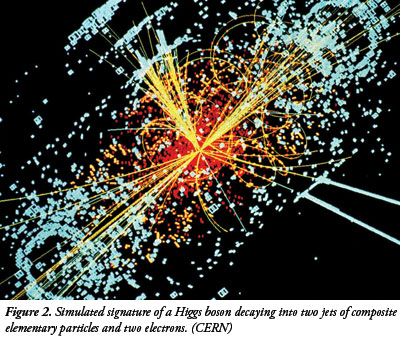
Experiments to find the Higgs boson are currently being performed using the Large Hadron Collider (LHC) at the European Organization for Nuclear Research (CERN) in Switzerland, shown in Figure 1. The LHC is expected to be able to answer the question of whether or not the Higgs boson actually exists. One possible signature from a simulated proton-proton collision that would demonstrate the Higgs boson’s existence is shown in Figure 2. The Higgs boson is believed to decay almost immediately after such a collision into two jets of hadrons (composite particles made of subatomic elementary particles held together by strong nuclear forces) and two electrons, visible in Figure 2 as lines. In December 2011, two experiments at the LHC independently reported that their data hint that the Higgs particle probably exists with a mass of about 133 proton masses. The range of mass for the Higgs particle is now thought to have been narrowed considerably to between approximately 122 and 138 protons. It is expected that the LHC will have a definite answer by the end of 2012.5
Why Scientists Dislike the Term “God Particle”
The Higgs boson doesn’t have any specific religious connotations, but it may help unlock processes that occurred at the time of creation. “Calling it the ‘God particle’ is completely inappropriate,” said Oliver Buchmueller, from the German research team of “Higgs hunters” at CERN. “It’s not doing justice to the Higgs [boson] and what we think its role in the universe is. It has nothing to do with God.”6
Scientists hope to discover the invisible Higgs field because the theory of its existence is foundational to the proponents of the Big Bang, the most typically accepted explanation for the origin of mass and space. Those who embrace the idea that the universe came into existence through rapid expansion during conditions of extreme density and heat, that planets and life resulted from the Big Bang, and that matter obtained mass because of a cosmological collision anticipate the discovery of this “God particle.”
In the 1960s, British scientist Peter Higgs first proposed the existence of the new physics field, now known as the Higgs field, as an explanation for differences between strong and weak fields in physics. The proposal developed into the idea that in the Higgs field, interaction between the electromagnetic field and the weak field resulted in matter taking on mass. The nickname “God particle” describes the agent that supposedly gave mass to the most basic building block of the universe.
“Without it, or something like it, particles would just have remained whizzing around the universe at the speed of light.…Hearing it called the ‘God particle’ makes me angry. It confuses people about what we are trying to do here at CERN” said Pippa Wells, a researcher with CERN’s Atlas team.7 A spokesman for CERN, James Gillies, agrees with Wells: “Of course it has nothing to do with God whatsoever….But I can understand why people go that way because the Higgs [boson] is so important to our understanding of nature.”8
According to people who have investigated the subject, the term “God particle” originated with a 1993 book by U.S. Nobel Prize winner Leon Lederman about the history of particle physics, The God Particle: If the Universe Is the Answer, What Is the Question?9 Yet others who recognize how significant the current research on the Higgs boson is continue to use religious themes for it. Lisa Randall, a theoretical particle physicist and cosmologist at Harvard University, recently entitled her latest book Knocking on Heaven’s Door.10 She wasn’t thinking about the God of the Bible, however, but about natural laws that cause particles to be organized and exhibit mass. She believes, for example, that the Higgs field associated with Higgs particles causes space to function like a fluid causing particles which move through it to exhibit mass.
And, yet, neither Randall nor any other scientist can explain where such natural laws originated. Her physics is based upon a pantheistic view of the universe, at best. It’s legitimate to try and understand how mass, space, and time originated, but not if the processes we use to explain their origin don’t involve the Creator. The search for the “God particle” is an attempt to understand the Big Bang theory more fully. The Big Bang says that the universe began as an infinitesimal point and expanded outward, creating space and mass billions of years ago. Although this idea may seem consistent with the description of creation in Genesis 1:1, it is thought to have happened billions of years ago, while the Bible says it happened in one 24-hour day only a few thousand years ago. The theory is also presented as a natural event that didn’t require God’s involvement.
Several years ago, Carl Sagan declared to me through correspondence his full confidence in the Big Bang theory and its billions of years, but he admitted to one major problem. He couldn’t understand where the laws of nature came from. He realized that his view of origins depended upon the laws of nature being present first. Yet he had no explanation for their origin because he didn’t believe in God. Scripture provides the reason why he had this problem: “But without faith it is impossible to please him: for he that cometh to God must believe that he is, and that he is a rewarder of them that diligently seek him” (Hebrews 11:6).
Conclusion
Sadly, scientists who have the best seat in the house to observe God’s handiwork through a microscope or a telescope often seem to be the first to deny that He is the Creator. Because they deny He is Creator, they fail to grasp the ultimate explanation for the world around us. Scripture says it best: “For the invisible things of him from the creation of the world are clearly seen, being understood by the things that are made, even his eternal power and Godhead; so that they are without excuse” (Romans 1:20).
References
  1. Morris, H. M. 1976. The Genesis Record. Grand Rapids, MI: Baker Book House, 17-36.
  2. Ibid, 41.
  3. Morris, H. M. 1982. Men of Science, Men of God. San Diego, CA: Master Books.
  4. Griffiths, D. 2008. Introduction to Elementary Particles, 2nd ed. New York: Wiley-VCH.
  5. Reich, E. S. Detectors home in on Higgs boson. Nature News. Posted on nature.com December 13, 2011.
  6. Evans, R. The Higgs boson: Why scientists hate that you call it the ‘God particle.’ Reuters, December 14, 2011.
  7. Ibid.
  8. Ibid.
  9. Lederman, L. and D. Teresi. 2006. The God Particle: If the Universe Is the Answer, What Is the Question? New York: Dell Publishing.
  10. Randall, L. 2011. Knocking on Heaven’s Door. New York: Harper Collins Publishers.
* Dr. Vardiman is Senior Research Scientist, Astro/Geophysics at the Institute for Creation Research.
Cite this article: Vardiman, L. 2012. Did the “God Particle” Create Matter? Acts & Facts. 41 (3): 12-14.

Does God Exist - Six Reasons to Believe that God is Really There - Existence of God - Proof of God

Does God Exist - Six Reasons to Believe that God is Really There - Existence of God - Proof of God